Tuesday, 18 June 2013

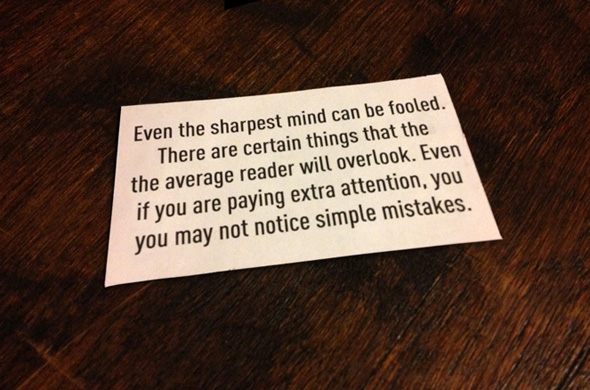
Test For The Sharp Minded


via Mighty Optical Illusions http://www.moillusions.com/2013/06/test-for-the-sharp-minded.html

Here is another intriguing #test for the sharp minded. Check out the reading card below, and see if you can spot the illusion immediately. Actually it’s a very simple test, so no hints will be provided. When you’re finished, and think you got it – check the solution and see if you were right! BTW, am glad you liked our previous “Single Photo Illusion“, I think it was magnificent as well!


Test For The Sharp Minded


Crafty Puzzles

Buzz Bites (6/18/13): Watch Miley Cyrus' 'We Can't Stop' Teaser - Buzzworthy


via brain teasers - Google News http://news.google.com/news/url?sa=t&fd=R&usg=AFQjCNF-wdMHUQxZFZnr4sZWFWrmiEqG_A&url=http://buzzworthy.mtv.com/2013/06/18/miley-cyrus-we-cant-stop-video-teaser/

11 'Google Interview' Questions, And How To Get Them Right - Huffington Post UK


via brain teasers - Google News http://news.google.com/news/url?sa=t&fd=R&usg=AFQjCNEiLd4UqxsmZhEfejq1Ekcb2S9DIQ&url=http://www.huffingtonpost.co.uk/2013/06/18/google-interview-questions_n_3458986.html

Monday, 17 June 2013

Today's Daily Brain Teaser (Jun 18, 2013)

Pertaining Interest


What is short enough to gain interest and long enough to cover the subject?


Check Braingle.com for the answer.

Today's Daily Trivia Quiz (Jun 18, 2013)

Batman 1966

Greetings, Citizen! Bruce Wayne and his young ward, Dick Grayson, had secret alter egos as TV crime fighters Batman and Robin. The Dynamic Duo battled villains in Gotham City from 1966 to 1968. The popular parody translated characters from the DC Comics serial of the same name.


Take the Quiz at Braingle.com

Creativity : Thinking Fluently

One of the things you notice about creative people is that they are extremely prolific thinkers. They produce tons and tons of ideas both good and bad. A creative thinker is constantly rethinking and recombining ideas into different permutations.


To be a creative thinker, try to force relationships between seemingly unconnected ideas, and don't be afraid to record an idea that you're not sure is correct. You can always come back to it later and combine it with something else to get a new idea. Go for quantity in your ideas and try not to censor yourself.

Memory : SQ3R

SQ3R is an acronym for a popular study system that will help you get the most from your studying. SQ3R stands for Survey, Question, Read, Recite, and Review. It's a good system to use if you are trying to learn the material in a textbook.


Survey


In this first step, you should take no more than 5 minutes to get an overview of what the chapter or book is about. Read the preface, table of contents, chapter titles, headings, graphs, summaries, etc. This will give you an outline of what you are about to learn which will help you know what to expect.


Question


Survey the material again, but stop at each section and ask yourself some questions about what you hope to learn by reading that material. This step helps increase your interest in the topic and focus your attention on what you will be learning.


Read


Read the material. Don't take notes or highlight anything yet. The first time you read through the material, you don't yet know which facts are important, so taking notes is difficult and inefficient.


Recite


In this step, you should try to answer the questions you asked in the Question step. Look back at the material only if necessary. Talking out loud to yourself isn't necessary, but it can help reinforce the information. Recitation also provides Feedback. Spend at least half of your time on this step.


Review


Survey the book again and take note of which areas you were able to recite successfully and which areas you were not. You can study the weak areas again later. A review right after studying will help solidify the material in your mind. Periodic reviews at later dates will refresh your memory and help relearn material that you have forgotten.